To improve table turnover, you need to eliminate dead time without rushing the dining experience. Restaurants that optimize turnover thoughtfully, focusing on seating, payment, and table reset, often increase covers by 20-30% without any negative impact on guest satisfaction.
A restaurant with 20 tables that turns each table twice during dinner service effectively has 40 tables worth of revenue potential. Table turnover rate is the multiplier that transforms your fixed seating capacity into variable earning power. It’s the intersection of operational efficiency and guest experience. Push too hard and you sacrifice hospitality; ignore it and you leave money on the table.
Key takeaways
- Main solution: Eliminate dead time in seating, payment, and table reset
- Expected result: 0.5-1.0 additional turns per service period
- Time to implement: Immediate for some changes, 1-2 weeks for process improvements
- Cost: Free to low cost (process changes, potential equipment investment)
Before you start
Understanding your current performance is the foundation for improvement.
What you’ll need:
- Reservation and seating data from the past 30 days
- Time tracking capability (can be manual for initial assessment)
- Staff input on bottlenecks
- Understanding of your concept’s target turn time
Calculate your current rate:
If you have 25 tables and served 62 parties during dinner service, your turnover rate is 2.48 turns.
Track by segment:
- Service period (lunch vs. dinner)
- Day of week
- Table size (2-tops vs. 6-tops)
- Section (bar vs. dining room)
Step 1: Understand your target turnover
Your target depends entirely on your concept. Chasing fast-casual numbers at a fine dining establishment would destroy your brand.
What to do:
- Identify your restaurant category
- Set a realistic target based on benchmarks
- Calculate the revenue impact of improvement
- Communicate the target to your team
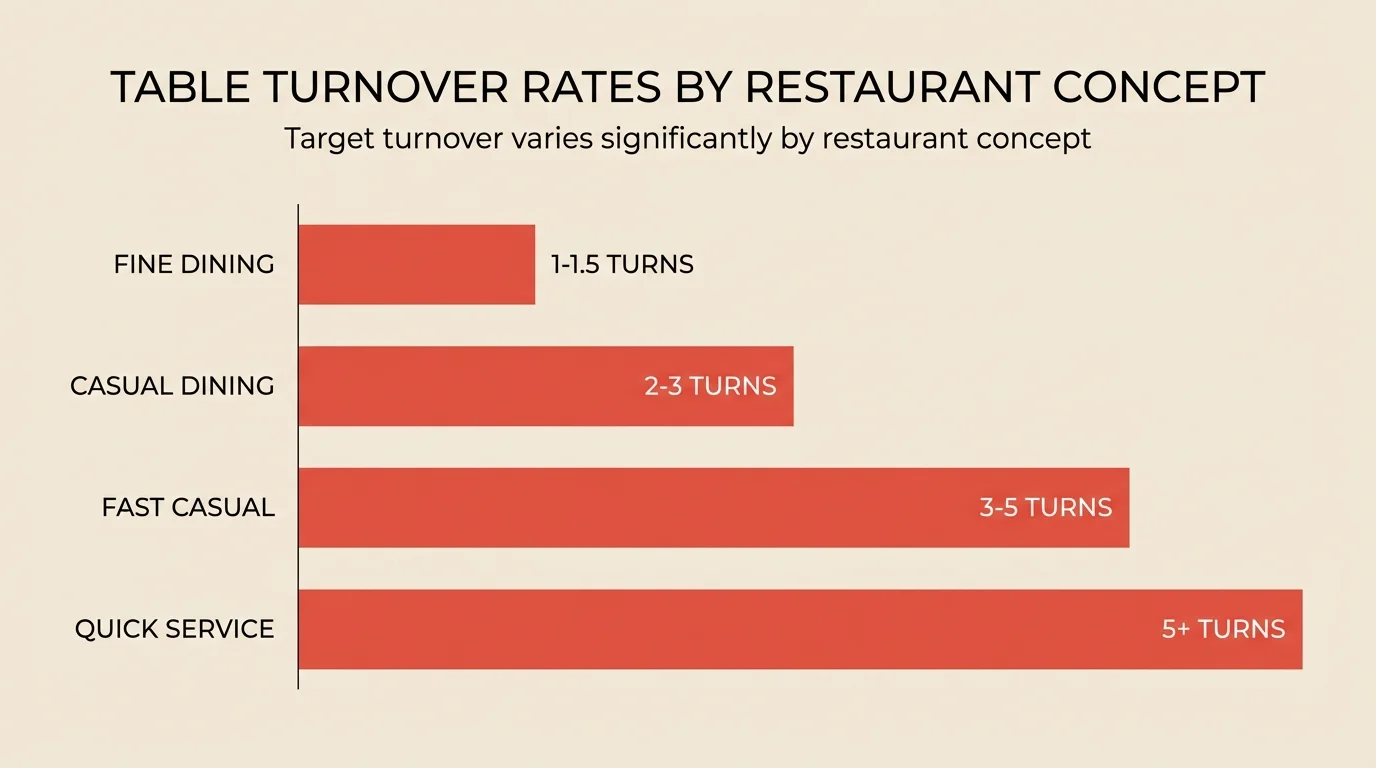
Benchmarks by restaurant type:
| Restaurant type | Typical turnover | Average dining time |
|---|---|---|
| Fine dining | 1.0-1.5 turns | 90-120 minutes |
| Casual dining | 2.0-3.0 turns | 45-60 minutes |
| Fast casual | 3.0-5.0 turns | 20-30 minutes |
| Quick service | 5.0+ turns | 10-20 minutes |
The right question isn’t “how do I get more turns?” but “am I getting the turns my concept should support?”
Step 2: Identify your bottlenecks
Turnover isn’t about rushing guests. It’s about eliminating wasted time that doesn’t add value for anyone.
What to do:
- Map the guest journey from arrival to departure
- Time each phase: seating, ordering, food delivery, check, payment, reset
- Identify where time is lost without guest benefit
- Prioritize fixes by impact
Common bottleneck areas:
| Phase | Common issues | Typical time lost |
|---|---|---|
| Pre-arrival | Table not ready, waiting for bussing | 5-10 min |
| Seating | Host bottleneck, menu delivery delay | 3-5 min |
| Ordering | Slow greeting, server unavailable | 5-10 min |
| Food delivery | Kitchen ticket times, expo delays | Variable |
| Check/payment | Waiting for check, card processing | 10-15 min |
| Reset | Table clearing, re-setting | 5-10 min |
Pro tip: Sit with a stopwatch during service. Time each phase for 10 tables. The data will reveal your biggest opportunities.
Step 3: Speed up seating
Dead time before guests even sit down is pure waste.
What to do:
- Track table status in real-time
- Start bussing before guests leave
- Pre-set tables during slower moments
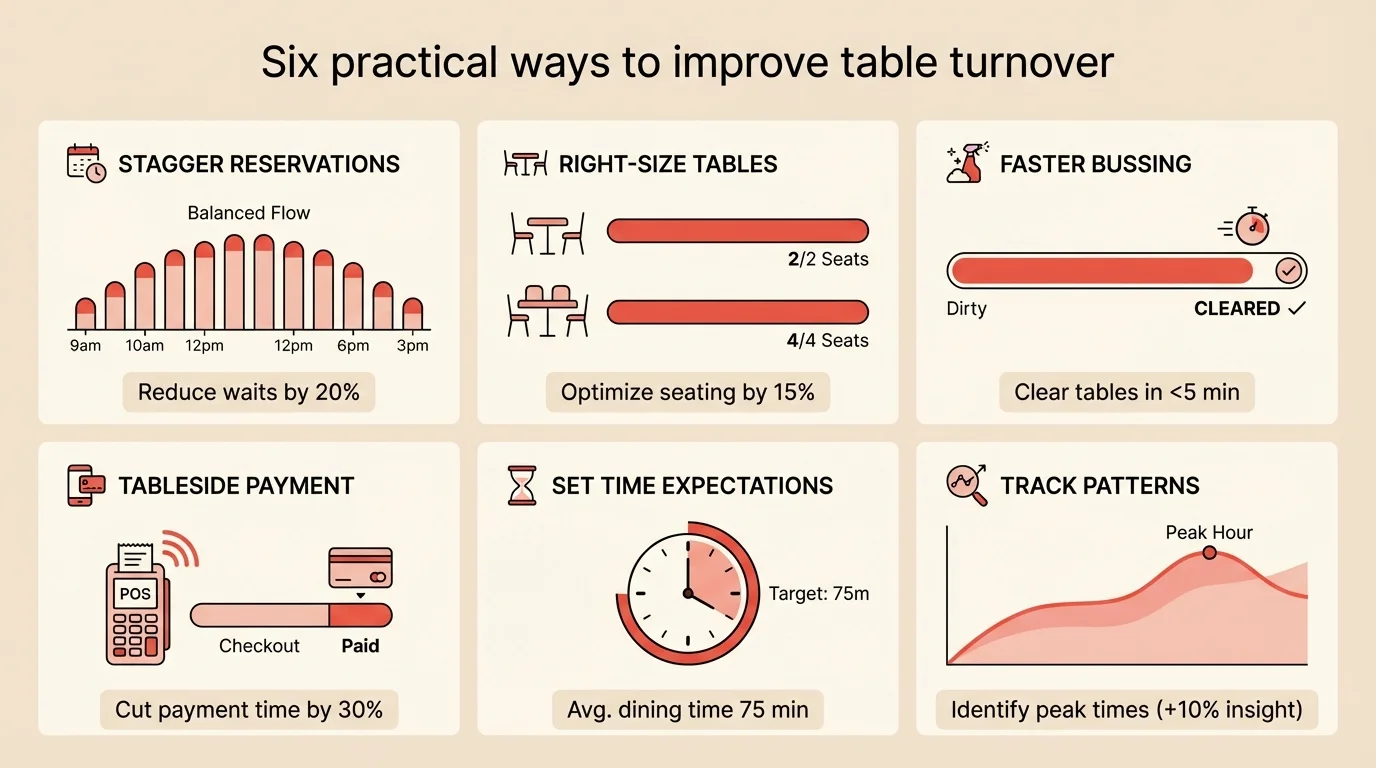
- Stagger reservation times
Table status tracking: Your host should always know which tables are:
- On dessert/check (ready soon)
- Just seated (30+ minutes away)
- Being cleared (ready in 2 minutes)
Pre-bussing: Train servers to clear plates as courses finish, not after the meal ends. This shaves minutes off reset time.
Stagger reservations: Instead of all 7pm reservations, book 6:45, 7:00, 7:15. This staggers turns and smooths kitchen flow.
Step 4: Streamline payment
Payment processing is often the single biggest turnover killer. Guests are ready to leave but stuck waiting.
What to do:
- Measure current check-to-departure time
- Evaluate tableside payment options
- Train servers on proactive check delivery
- Consider pay-at-table technology
The payment timeline problem: Traditional payment flow:
- Guest signals for check (wait 2-3 min)
- Server delivers check (wait 2-3 min)
- Guest provides card (wait 2-3 min)
- Server processes and returns (wait 2-3 min)
Total: 8-12 minutes of dead time
Tableside terminals: Cut this to 2-3 minutes. Guest inserts card, tips, and leaves. No trips back and forth.
Proactive check delivery: Train servers to offer the check when clearing dessert plates, not to wait for a signal. “No rush at all, just wanted to get this to you whenever you’re ready.”
Step 5: Optimize table reset
The time between parties is pure cost. Minimize it without sacrificing presentation.
What to do:
- Time your current reset process
- Invest in dedicated busser coverage
- Standardize the reset procedure
- Pre-position supplies
Busser investment: A dedicated busser can cut table reset time in half. Often the best ROI hire for improving turnover.
Reset procedure: Create a standard sequence:
- Clear dishes (30 seconds)
- Wipe table (30 seconds)
- Reset silverware and napkins (30 seconds)
- Final check and signal host (15 seconds)
Total: 2 minutes or less
Supply positioning: Keep clean silverware, napkins, and menus at server stations, not in a back room. Every trip to the back adds time.
Step 6: Match parties to tables
A 2-top at a 4-top is wasted capacity. Right-sizing improves effective turnover even without faster turns.
What to do:
- Track your party size distribution
- Compare to your table mix
- Adjust configurations where possible
- Train hosts on optimal seating
Party size analysis: If 45% of your parties are 2 people but only 20% of your tables are 2-tops, you’re constantly wasting capacity.
Options:
- Add more 2-tops
- Use bar seating for smaller parties
- Invest in flexible/modular tables
- Seat 3-person parties at 2-tops with a third chair
For more on optimizing table mix, see capacity planning.
Step 7: Set expectations for high-demand times
For peak periods, communicate table times upfront. Guests appreciate clarity.
What to do:
- Define table time limits for peak periods
- Communicate at booking
- Include in confirmation messages
- Train staff on polite reminders
How to communicate: “We have a 90-minute seating for Friday dinner reservations. This ensures we can seat all our guests while still giving you plenty of time to enjoy your meal.”
Mid-meal reminders: If a table is approaching their time limit with a waitlist, a gentle check-in works: “How’s everything going? Just wanted to make sure you have everything you need. Take your time, and I’ll bring the check whenever you’re ready.”
Common mistakes to avoid
Rushing guests
Guests who feel rushed don’t come back. A 3-turn night with unhappy guests beats a 4-turn night that kills your reputation. Improve process, not pace.
Optimizing the wrong tables
Your 2-tops might turn great while 6-tops sit underutilized. Focus on where you’re actually losing capacity.
Measuring without acting
Knowing your turn rate is useless if you don’t identify what’s slowing you down. Track where time is lost, not just how much.
Ignoring no-shows
A table held for a no-show is a table that can’t turn. Confirmation systems and strategic overbooking directly impact turnover.
One-size-fits-all approach
Lunch turns faster than dinner. Weekdays differ from weekends. Set targets and processes by segment.
How to measure success
Track these metrics weekly:
| Metric | Before | Target | How to track |
|---|---|---|---|
| Average turns per service | Your baseline | +0.5 turns | Parties / tables |
| Check-to-departure time | Time it | Under 5 minutes | Sample timing |
| Table reset time | Time it | Under 3 minutes | Sample timing |
| RevPASH | Calculate baseline | +15-20% | Revenue / (seats x hours) |
Calculate the revenue impact:
For a 50-seat restaurant:
- Current: 2.0 turns = 100 covers
- Target: 2.5 turns = 125 covers
- Extra 25 covers at $65 = $1,625/night
- Monthly impact: ~$49,000 in additional capacity
Tools that help
Modern reservation systems support turnover optimization with real-time visibility.
Table management with live status tracking shows which tables are turning and which are stuck.
Analytics identify your actual turn times by table, server, and time period.
Pacing controls let you stagger reservations automatically to smooth service flow.
Waitlist integration fills tables immediately when they become available.
If your system doesn’t provide this visibility, Resos includes table management with real-time status and analytics.
Frequently Asked Questions
What is a good table turnover rate for restaurants?
How do I increase turnover without rushing guests?
Should I set time limits on reservations?
Does table turnover affect revenue per seat?
What's the biggest turnover killer in most restaurants?
The bottom line
Table turnover is a multiplier on your fixed capacity. Improving from 2.0 to 2.5 turns increases your revenue potential by 25% without adding a single seat.
Focus on eliminating dead time, not rushing the dining experience. The biggest wins usually come from payment processing, table reset, and seating efficiency. These improvements benefit guests too. Nobody likes waiting for their check.
Start by timing your current process. Identify the biggest bottleneck. Fix that one thing. Then measure again and move to the next.
Related guides: Best table management software | RevPASH | Capacity planning | Waitlist management