To manage your waitlist effectively, you need accurate time estimates, proactive communication, and a system that converts waiting guests into seated covers. Restaurants with well-run waitlists convert 80%+ of waitlist adds into seated guests, while poorly managed lists see 35%+ walkaway rates.
A waitlist isn’t a problem to manage. It’s demand you haven’t captured yet. Every party that joins your waitlist represents potential revenue. Every party that walks away is revenue walking out the door. The difference between these outcomes comes down to how well you manage the wait.
Key takeaways
- Main solution: Digital waitlist with SMS notifications + accurate time estimates + bar seating during wait
- Expected result: 80%+ waitlist conversion rate, reduced walkaway rate
- Time to implement: 1-2 hours for setup, ongoing optimization
- Cost: Free to $50/month for digital waitlist tools
Before you start
Effective waitlist management starts with understanding your current performance.
What you’ll need:
- Digital waitlist system (or plan to implement one)
- Historical data on turn times by party size
- Bar seating or waiting area for guests
- Staff trained on communication and timing
Know your numbers: Track for one week before making changes:
Also track:
- Average wait time by party size
- Quote accuracy (quoted time vs. actual time)
- Current conversion rate (seated vs. added)
If walkaway rate exceeds 20%, your quotes are probably too optimistic or communication is poor.
Step 1: Capture guest information properly
Every waitlist add should capture the information you need to communicate and seat efficiently.
What to do:
- Get name and party size (obviously)
- Collect phone number for SMS notifications
- Note any special requests (high chair, accessibility)
- Record the time added for accurate tracking
Information to capture:
- Guest name
- Party size
- Phone number (required for SMS)
- Special requests
- Time of waitlist add
Pro tip: Make phone number required. Guests who won’t give a number are more likely to leave without telling you. The phone number is your communication lifeline.
Step 2: Give accurate time estimates
Guests can handle long waits. They can’t handle being lied to. Accurate quotes build trust; optimistic quotes create frustrated guests.
What to do:
- Track actual wait times by party size and day
- Build a baseline from historical data
- Adjust in real-time based on floor conditions
- Add a small buffer to underpromise
Calculate your baseline:
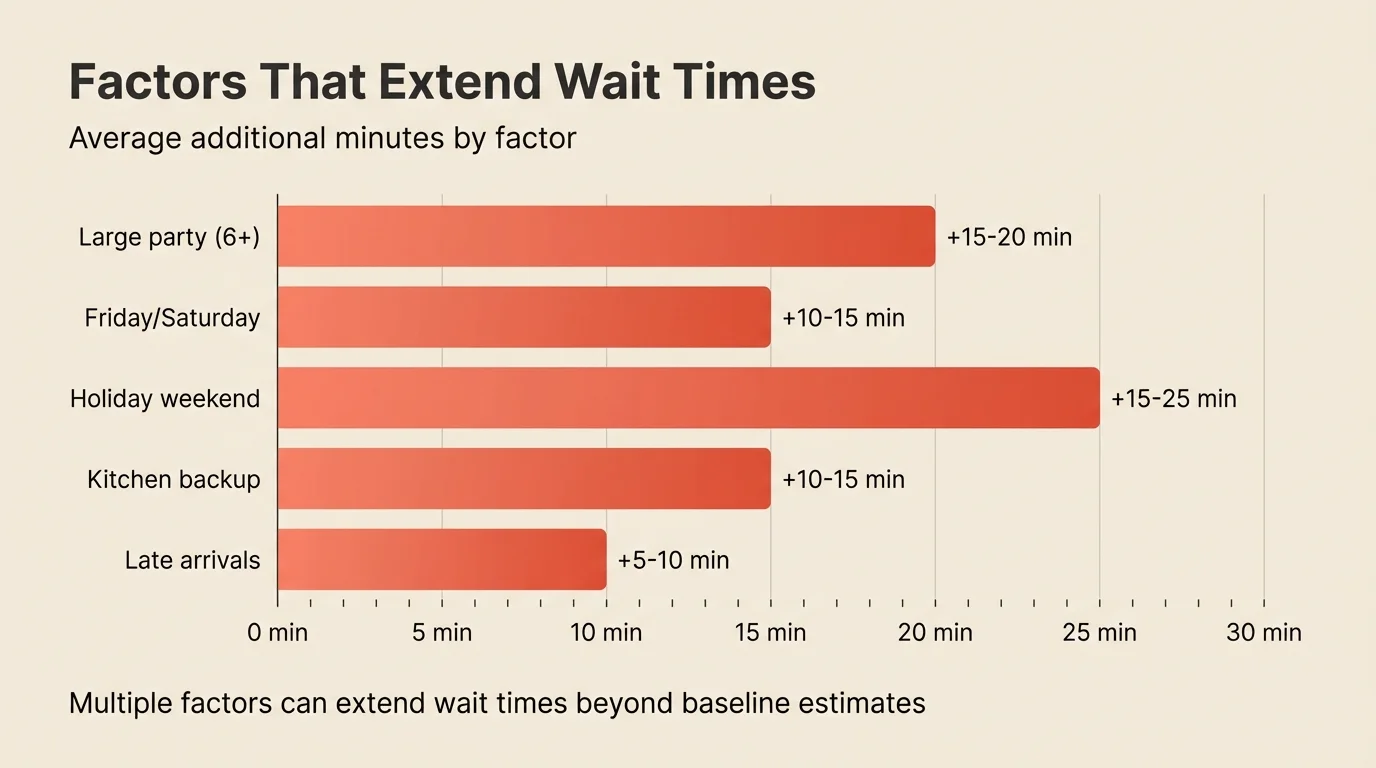
Break this down by party size and day/time. Your 2-top Friday 7pm wait is different from your 6-top Tuesday 6pm wait.
Adjust for floor conditions:
- How many tables are on dessert/check?
- Any large parties about to turn?
- Is the kitchen running slow tonight?
- Any reservations about to no-show?
Build in buffer: Quote slightly longer than your estimate. A 25-minute wait that takes 20 minutes creates a happy guest. A 20-minute wait that takes 25 creates a frustrated one.
Step 3: Communicate proactively
Guests waiting without updates assume the worst. They wonder if they’re forgotten, check with the host repeatedly, or simply leave. Proactive updates keep guests committed.
What to do:
- Send confirmation text when added to waitlist
- Provide updates if wait time changes significantly
- Notify immediately when table is ready
- Follow up if they don’t respond
Communication sequence:
- Add to waitlist: “You’re on our waitlist. Estimated wait: 25 minutes. We’ll text when your table is ready.”
- Time update (if needed): “Still working on your table. Looks like about 15 more minutes. Thanks for your patience.”
- Table ready: “Your table is ready! Please head to the host stand within 5 minutes.”
- No response: “Still want your table? Please reply or let us know. We’ll move to the next party in 5 minutes.”
What to avoid:
- Radio silence during the wait
- Optimistic updates that don’t materialize
- Passive-aggressive language about response times
Step 4: Use a digital waitlist system
Paper waitlists still exist, but digital systems offer significant advantages that directly impact revenue.
What to do:
- Implement a digital waitlist system
- Train staff on using it consistently
- Configure SMS notifications
- Set up tracking for wait times and conversion
Digital vs. paper comparison:
| Aspect | Paper | Digital |
|---|---|---|
| Guest communication | Call names, phone calls | Automated SMS updates |
| Guest freedom | Must stay nearby | Can wait anywhere |
| Data tracking | Manual tallies | Automatic analytics |
| No-show handling | Lose track | Automatic removal |
| Accuracy | Guesswork | Historical data |
The biggest win: Guests don’t have to hover near the host stand. They can browse nearby shops, wait in their car, or sit at the bar. This reduces lobby congestion and walkaway pressure.
Step 5: Convert wait time into revenue
A guest waiting is an opportunity, not just a queue. Turn wait time into bar revenue and future bookings.
What to do:
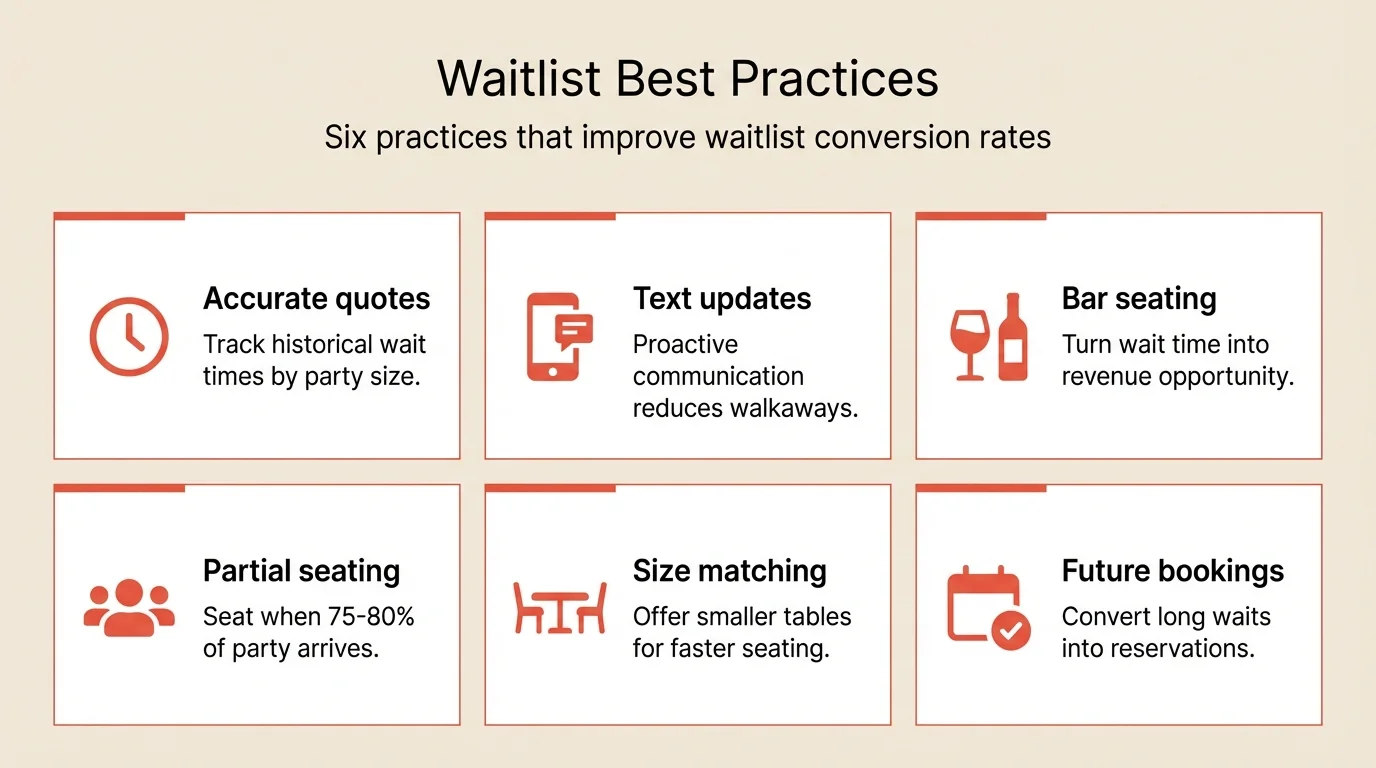
- Train hosts to suggest bar seating for every waitlist party
- Track bar revenue from waitlist guests
- Offer to book future reservations if wait is too long
- Provide options for flexible party sizes
Bar seating drives revenue: Every minute a guest waits at the bar is potential drink revenue. Script for hosts: “The bar has seating available while you wait. We’ll come get you when your table’s ready.”
Capture future reservations: Guest leaving because the wait is too long? Offer to book them for another night. Turn a lost cover tonight into a guaranteed cover later.
Manage party size flexibility: “We have a 2-top available now, or you can wait 15 more minutes for a 4-top.” Many 3-person parties will take the 2-top. Offer options rather than assuming.
Step 6: Handle common scenarios
Every busy night brings situations that can derail your waitlist. Have protocols ready.
What to do:
- Document standard procedures for common scenarios
- Train staff on handling each situation
- Empower hosts to make reasonable decisions
- Review and adjust procedures as needed
The vanishing guest: Text notification sent, no response. Protocol:
- Wait 3-5 minutes
- Send follow-up text or call once
- No response in 5 more minutes = move to next party
- Keep their spot for 15 minutes total, then remove
The early arrival: Guest on waitlist asks to be seated at a reserved table that’s empty. Options:
- If reservation is 30+ minutes out, seat them with clear time limit
- If reservation is imminent, explain the table is held
- Offer bar seating while they wait
The impatient party: Guest complains wait is too long. Acknowledge, don’t argue:
- “I understand the wait is frustrating. Based on what I see on the floor, I expect about 10 more minutes.”
- Offer bar seating if available
- If they’re hostile, it’s okay to let them leave. An angry guest damages everyone’s experience.
The partial party: “We’re 4 but 2 are running late.” Options:
- Seat the 2, hold the table spots
- Wait until party is mostly complete (3 of 4)
- Clear policy: “We seat parties when 80% are present”
Step 7: Track and optimize your metrics
What gets measured gets improved. Track waitlist performance to find opportunities.
What to do:
- Track key metrics weekly
- Identify patterns and problems
- Adjust procedures based on data
- Set targets and monitor progress
Metrics to track:
| Metric | Formula | Target |
|---|---|---|
| Walkaway rate | Guests left / total adds | Under 20% |
| Quote accuracy | Actual wait / quoted wait | 0.8-1.0 |
| Conversion rate | Seated / total adds | 80%+ |
| Bar conversion | Waitlist guests at bar / total waitlist | 30%+ |
Interpreting quote accuracy:
- Below 0.8: You’re quoting too conservatively (leaving tables empty)
- Above 1.0: You’re underquoting (frustrating guests)
- Target: 0.9-1.0 (slight underpromise, over-deliver)
Common mistakes to avoid
Optimistic quotes to avoid awkward conversations
Telling guests 20 minutes when you know it’s 40 creates angry guests when reality hits. Quote honestly, even if some people leave.
Not using phone numbers
If you’re still calling names in the lobby, you’re losing guests. SMS allows guests to wait comfortably and gives you a direct line when tables open.
Ignoring the bar opportunity
Waitlist guests standing by the door are uncomfortable and likely to leave. Guests at the bar with drinks are comfortable and spending money.
Treating all parties equally
A 2-top waiting for any 2-top is different from a 6-top waiting for a specific configuration. Track and communicate differently.
No fallback for no-shows
When a waitlist guest doesn’t respond, have a clear procedure. Don’t hold tables indefinitely for ghosts.
How to measure success
Track these metrics weekly:
| Metric | Before (example) | Target | How to track |
|---|---|---|---|
| Walkaway rate | 25-35% | Under 15% | Left / total adds |
| Quote accuracy | 65-75% | 90-100% | Actual / quoted |
| Conversion rate | 60% | 80%+ | Seated / added |
| Bar revenue from waitlist | 15-20% | 30%+ ordering | Track by table |
Tools that help
Modern reservation systems include waitlist management that automates the hard parts.
SMS notifications send automatic messages when guests are added and when tables are ready. No more calling names in a crowded lobby.
Wait time tracking builds historical data so your quotes improve automatically over time.
Integration with reservations lets you see your full floor picture, including upcoming reservations that will free tables soon.
Analytics show conversion rates, walkaway patterns, and quote accuracy so you can optimize continuously.
If your current system doesn’t handle waitlists well, Resos includes waitlist management with SMS notifications and analytics.
Frequently Asked Questions
How do I give accurate wait time estimates?
Should I use a digital waitlist or paper?
How do I handle guests who leave the waitlist?
Should waitlist guests get priority over walk-ins?
How long is too long for a wait?
The bottom line
Your waitlist is a revenue-generation system, not just a holding pen. Start by tracking your current walkaway rate and quote accuracy. Implement SMS notifications if you haven’t already. Train hosts to offer bar seating to every waitlist party.
The restaurants that master waitlist management consistently fill more tables and create better guest experiences. Every party that walks away is money leaving your restaurant. Keep them engaged, keep them comfortable, and get them seated.
Related guides: Best restaurant waitlist apps 2026 | Capacity planning | Table turnover rate | No-show rate