To manage large party bookings well, define when the workflow changes, communicate the terms early, and give staff a consistent way to handle headcount and arrival changes. A large party is not automatically a higher no-show segment, but it can hold many covers and require more preparation than a standard reservation.
A party of 12 that does not arrive can affect more capacity than a missed 2-top. You may have joined tables, scheduled staff, prepared for a specific headcount, and turned away other reservations. Track the covers affected alongside the booking rate so the operational impact is visible.
This guide is the workflow. For the data behind it, including why large parties are recorded as the least likely party size to no-show and what that means for how hard you protect them, see do large parties no-show more?
For the latest party-size data and a copy-paste policy, see Large party reservations: the data and the policy.
Key takeaways
- Main solution: A threshold-based workflow with clear terms, headcount checkpoints, and an owner
- Expected result: Fewer avoidable surprises and more consistent service decisions
- Time to implement: 1-2 hours to document policies, ongoing enforcement
- Cost: Free (process changes only)
Before you start
Large parties need different handling than regular reservations when they change your table plan, kitchen preparation, staffing, or ability to replace the space. Start by defining the operational threshold for your restaurant.
What you’ll need:
- Definition of what counts as “large” for your restaurant
- Deposit collection capability in your system
- Policy documentation for staff and guests
- Pre-order menu options (recommended for 10+)
Define your thresholds:
| Party size | Treatment |
|---|---|
| Booking profile | Example treatment |
| ----------------- | ------------------ |
| Standard table plan | Standard reservation workflow |
| Joined tables or special area | Capture extra details and confirm the plan |
| High-demand service or difficult-to-replace space | Add a confirmation deadline and, where appropriate, a payment guarantee |
| Event-style or private booking | Use a separate written agreement |
Adjust based on your floor plan. If a 6-top requires pushing tables together, that’s your large party threshold.
Step 1: Set deposit requirements
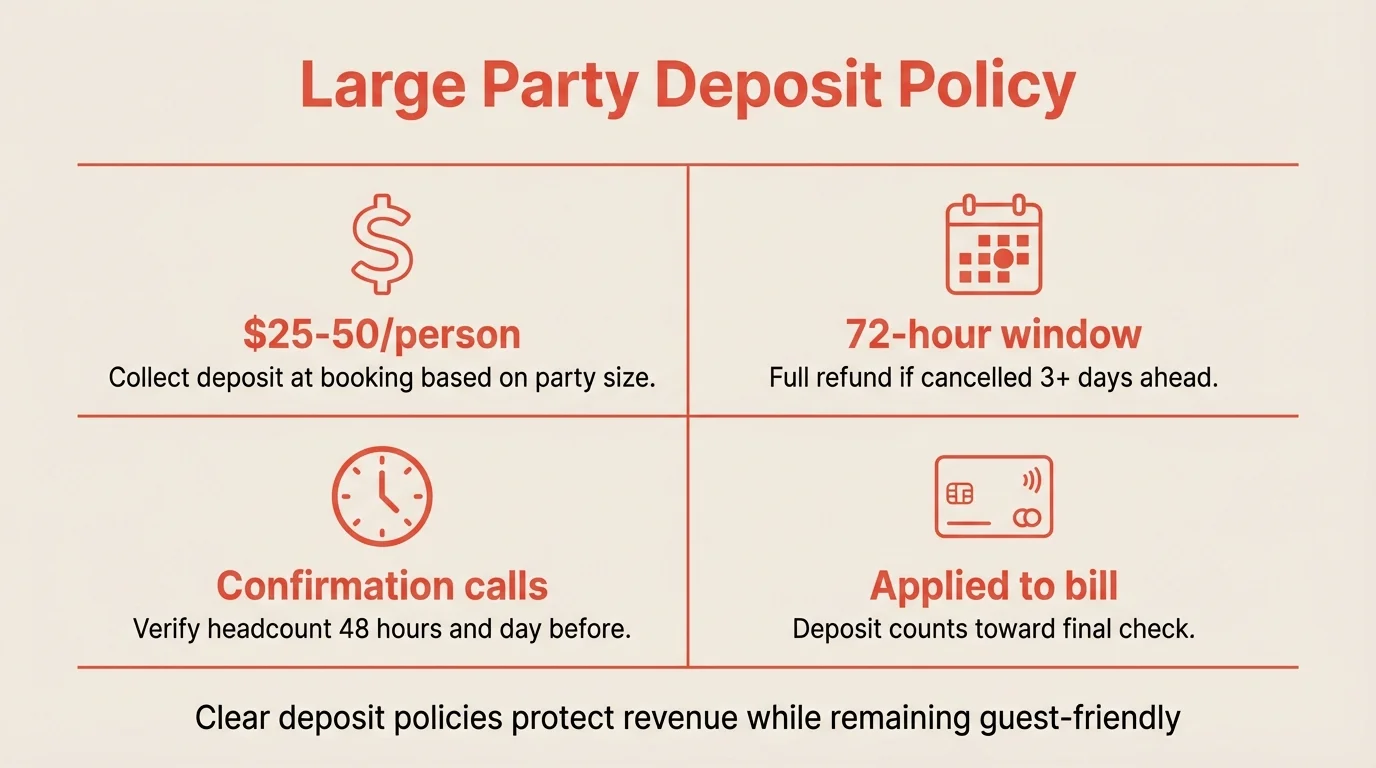
Payment terms can be useful for capacity that is difficult to replace, but they are a policy choice rather than a guaranteed no-show solution. The available party-size data does not establish that deposits cause lower recorded no-show rates.
What to do:
- Decide whether a payment guarantee fits the booking
- Set up collection in your reservation system
- Create clear cancellation terms
- Train staff on the policy
Possible payment structures:
- No payment requirement, with a written cancellation deadline
- Card guarantee, with the charge terms shown before confirmation
- Deposit applied to the final bill, with refund and cancellation terms stated clearly
- A separate event agreement for buyouts or private dining
Check every payment and cancellation term against local rules and your payment provider’s requirements. Do not copy another restaurant’s amounts or deadlines without checking whether they fit your operation.
Make policies crystal clear at booking and send written confirmation with the terms.
Step 2: Require appropriate lead time
Large parties need advance notice for kitchen prep, staffing, and table setup.
What to do:
- Set minimum lead time by party size
- Block same-day large party requests
- Require longer lead time for peak periods
- Build confirmation touchpoints into the timeline
Lead time requirements:
| Party size | Minimum lead time | Peak period lead time |
|---|---|---|
| 6-8 | 24-48 hours | 48-72 hours |
| 9-14 | 48-72 hours | 1 week |
| 15+ | 1-2 weeks | 2-3 weeks |
What lead time allows:
- Kitchen can order and prep appropriately
- You can schedule adequate staffing
- Tables can be configured in advance
- Deposits can be collected and confirmed
Step 3: Capture complete information upfront
Large party bookings require more details than standard reservations. Capture everything at booking.
What to do:
- Create a large party booking checklist
- Train staff to collect all required information
- Document in your reservation system
- Send confirmation with all details
Information to capture:
- Contact name and phone (not just email)
- Exact headcount with buffer (“confirmed 10, possibly 12”)
- Occasion (birthday, business dinner, celebration)
- Dietary restrictions and allergies
- Timing constraints (“must be out by 9pm”)
- Billing expectations (one check, split, company card)
Why this matters: Missing information creates problems night-of. A surprise birthday requires a dessert plan. Dietary restrictions need kitchen notice. Timing constraints affect table assignment.
Step 4: Implement pre-orders for 10+
Pre-ordering can simplify large-party service for the kitchen, staff, and guests when the menu and timing make it worthwhile.
What to do:
- Create 2-3 prix fixe options at different price points
- Require selections 48-72 hours before
- Include drink package options
- Collect dietary restrictions with pre-order
Pre-order benefits:
| Who | Benefit |
|---|---|
| Kitchen | Accurate prep quantities, staggered cooking |
| Servers | No lengthy ordering, predictable timing |
| Guests | Everyone eats together, clear pricing |
| You | Easier check splitting, reduced waste |
Prix fixe structure:
- Offer two or three menus with clearly different levels of choice
- Set a deadline for selections and record dietary requirements
- Explain whether the menu is optional or required for the booking
- Confirm how late changes and absent guests are handled
Pre-orders improve planning, but they do not guarantee attendance or revenue.
Step 5: Build a confirmation cadence
Large parties require multiple touchpoints to confirm headcount, timing, and details.
What to do:
- Send immediate booking confirmation
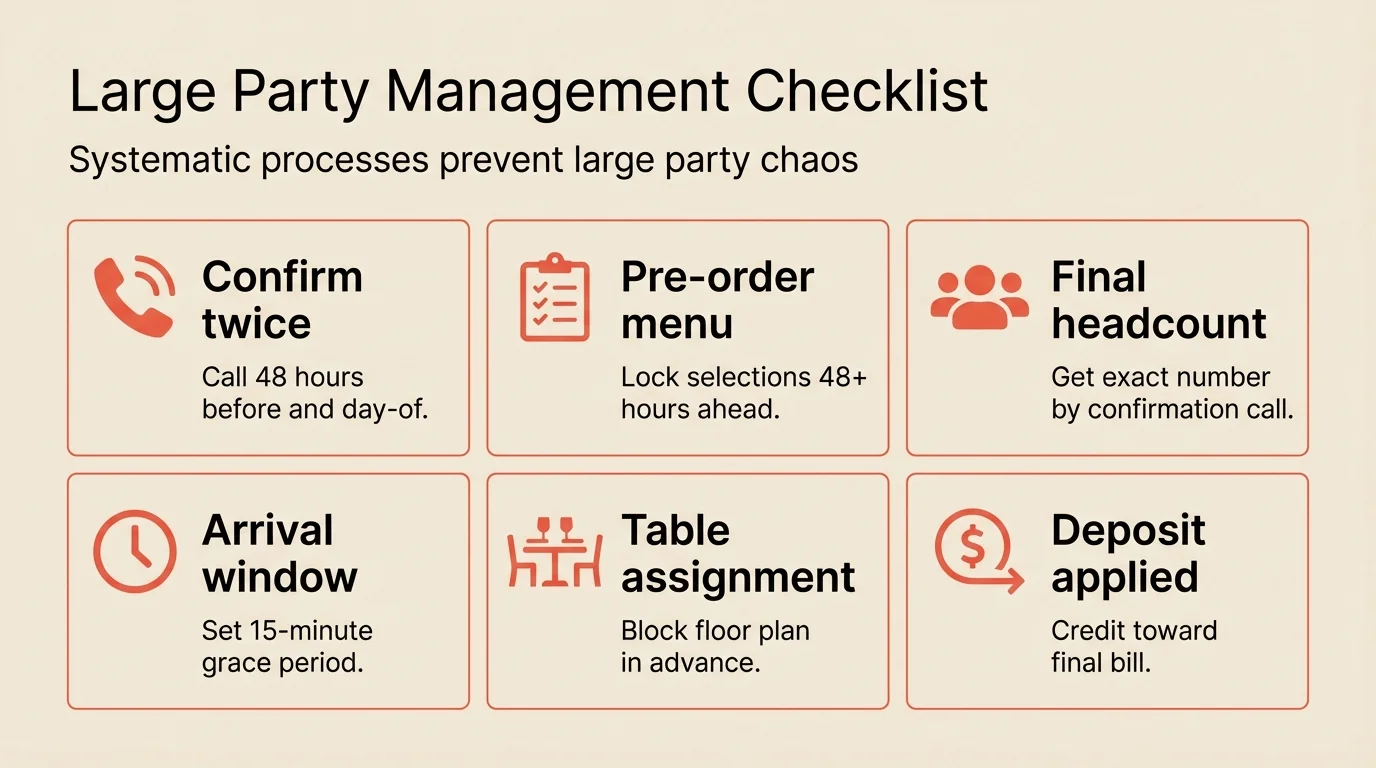
- Confirm 48-72 hours before
- Final confirmation day-of
- Document all confirmations
Confirmation timeline:
| Timing | Action | Goal |
|---|---|---|
| At booking | Send written confirmation | Document terms |
| 1 week before (15+) | Call to verify | Catch changes early |
| 48-72 hours before | Call for final headcount | Lock in numbers |
| Day before | Text reminder | Confirm timing |
What to confirm:
- Final headcount (get specific number)
- Arrival time
- Pre-order selections (if applicable)
- Special requests
- Payment arrangements
Step 6: Handle headcount fluctuations
Large parties rarely arrive at exactly the booked number. Build flexibility into your process.
What to do:
- Set headcount change policies
- Communicate policies at booking
- Document final count at confirmation
- Know when to charge for drops
Headcount policies:
| Change | Policy |
|---|---|
| Drop of 1-2 (under 20%) | Accommodate, no penalty |
| Drop after the confirmation deadline | Apply the terms shown at booking |
| Major drop that changes the table plan | Reconfigure where possible and explain the available options |
| Increase of 1-2 | Accommodate if possible |
| Large increase | Require 24+ hour notice |
At booking, communicate: “We’ll confirm your final headcount by [deadline]. Changes after that point may affect the table plan and the terms shown at booking.”
Step 7: Set arrival and seating policies
Large parties tend to trickle in. Clear policies prevent chaos.
What to do:
- Define your partial seating policy
- Set a hold time limit
- Communicate policies in confirmations
- Train hosts on enforcement
Arrival policies:
- Hold table for 15 minutes past reservation time
- Seat when 75-80% of party arrives
- Release table if no guests arrive within 20 minutes
How to communicate: “We’ll hold your table until 7:15 for your 7pm reservation. We’re happy to seat your party once most guests arrive. Let us know if you’re running late.”
Day-of management:
- Assign a manager or lead server to greet and coordinate
- Have a staging area if the full party isn’t ready to seat
- Brief kitchen on exact timing once party is seated
Common mistakes to avoid
Treating large parties like regular reservations
They need different lead times, policies, and communication. Build a separate workflow.
Applying exceptions inconsistently
Policies should apply consistently. If a manager makes an exception, record why so you can review whether the written rule needs improvement.
Underestimating setup time
Pushing tables together, setting for 14, and briefing the server takes longer than you think. Block time before the reservation.
Forgetting opportunity cost
That 14-top occupies space that could have seated other guests. Use your own service history to model the opportunity cost and set policy accordingly.
No backup plan for no-shows
Know what you’ll do if the 8pm 12-top doesn’t appear. Can you quickly reconfigure for walk-ins? Open seats on your waitlist?
How to measure success
Track these metrics for large party bookings:
| Metric | Baseline | Review | How to track |
|---|---|---|---|
| Recorded no-show rate | Your baseline | By party-size band | No-shows / eligible bookings |
| Late cancellation rate | Your baseline | By service period | Late cancellations / eligible bookings |
| Headcount accuracy | Your baseline | Over time | Actual vs. confirmed covers |
| Covers affected | Your baseline | With recovery | Booked covers on no-shows and late cancellations |
Calculate your opportunity cost:
Use your own average check, expected turns, and recovered capacity when modelling opportunity cost. Label the result as a planning model, not a recorded no-show fact.
Tools that help
Modern reservation systems support large party management with specialized features.
Deposit collection integrates into the booking flow, making it easy for guests and automatic for you.
Guest notes store all the details you captured at booking, visible to everyone who needs them.
Table blocking reserves the right configuration in advance, preventing accidental double-booking of the space.
Confirmation automation sends reminders at the right times, though you should still make personal calls for large parties.
If your system doesn’t support deposits or detailed notes, choose tools that make the policy visible to staff and guests. Keep the workflow understandable even when payment is not required.
Frequently Asked Questions
What size counts as a large party booking?
Should I require deposits for large parties?
How do I set a minimum spend for private events?
How far in advance should large parties book?
What if a large party is late or guests trickle in?
The bottom line
Large party bookings need special handling when they change your capacity or service plan. Define your threshold, capture complete information upfront, publish the terms, and confirm the final headcount.
The goal isn’t to make large parties difficult to book. It is to make the booking clear for guests and workable for the team.
Start by documenting your large party policy this week. Train your team on the process. Apply it consistently.
Related guides: Do large parties no-show more? | Prepayments and deposits | No-show rate | Capacity planning